AI disclosure: this content, including any imagery, was artificially generated.
Traditional tattoos are not a trend. They are a visual language built on bold black outlines, a small palette of solid colours, and classic motifs that have survived for over a century. Swallows, roses, daggers, anchors, panthers. These images endure because the formula works. The tattoo design generator will lay a subject out under these rules, so you can see how a motif reads with heavy outlines before you take it to an artist.
The heavy-lined approach holds its shape for decades. Ink spreads under skin as the years pass. A design with thick outlines and solid fills gives that spreading ink somewhere to go.
The result is a tattoo that still reads clearly at arm’s length when you are seventy. That is the entire point.
Where the style comes from
Traditional tattooing, often called American Traditional or Old School, grew out of the early twentieth century. Sailors brought designs back from their travels. Tattooers like Norman Collins, better known as Sailor Jerry, refined the look in Honolulu during the 1940s and 1950s.
The machines were crude by modern standards. Needles were thicker.
That limitation shaped the style.
Artists had to work fast and bold. Fine detail simply did not survive, which is the trade modern fine line work makes in reverse. So they developed a visual shorthand: heavy black lines to hold the design together, flat colour packed inside those lines, and minimal shading. The constraints became the aesthetic.
The rules that define traditional tattoos
Traditional tattoos follow a strict visual code. The outline is thick and black, usually done with a larger needle grouping. Inside that outline sits solid colour, typically red, green, yellow, and black.
Shading is minimal, often just a touch of black blended into the colour edge. There are no gradients, no photorealism, no soft edges.
This is not a style that rewards subtlety. It rewards clarity. A traditional tattoo should be readable from across the room.
The design fills the space it occupies. Background skin is left open, which makes the bold shapes stand out even more.
One common misconception is that traditional means simple. It does not. Drawing a clean, balanced traditional design takes years of practice.
Every line has to be deliberate. There is nowhere to hide mistakes.
What the classic motifs mean
The imagery carries a specific vocabulary. A swallow traditionally meant a sailor had travelled 5,000 nautical miles. It also symbolised the promise of return, since swallows always come back home.
A rose represents love and beauty, but paired with a dagger it becomes a warning about betrayal. Anchors stand for stability and grounding.
Panthers symbolise strength and cunning. Daggers speak to sacrifice and protection.
These meanings are not secret codes. They are shared cultural references. You do not need to earn a swallow through sea travel to wear one today.
But knowing the history adds depth to the choice. A tattoo that references a century of visual tradition carries weight that a random design does not.
Why traditional tattoos age so well
All tattoos age. Ink particles break down and drift slightly under the skin. Sun exposure fades colour.
Skin loses elasticity. These are facts, not flaws.
The question is which designs survive that process best.
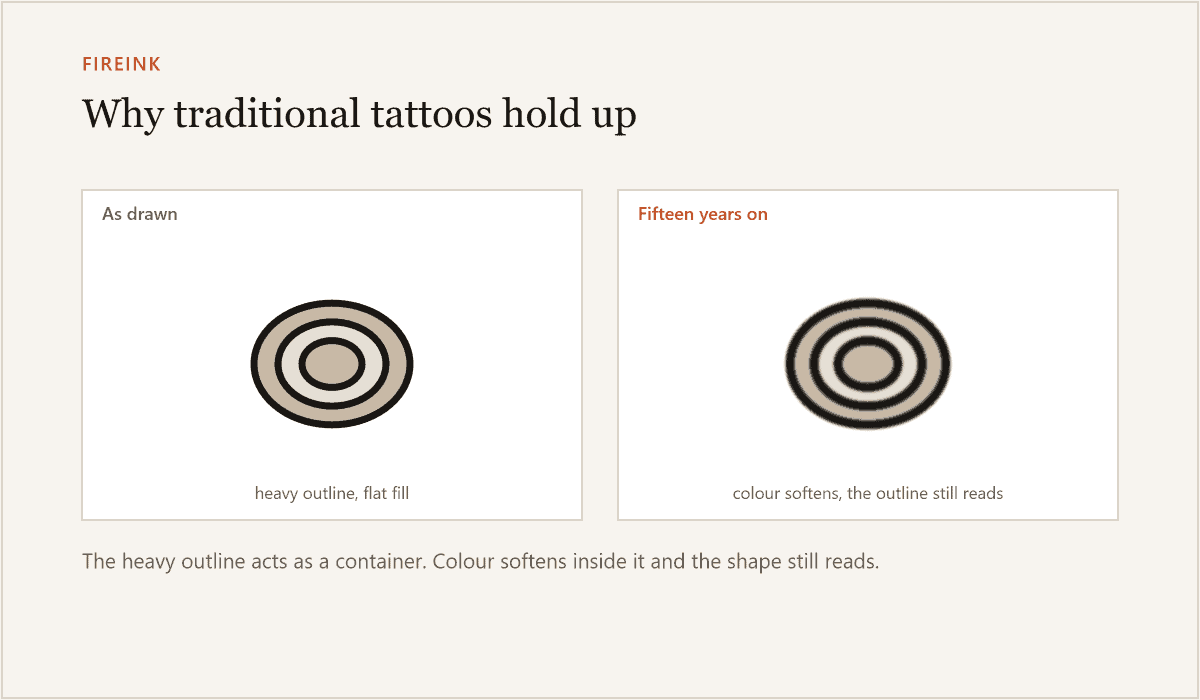
Traditional work survives because it anticipates the ageing process. The thick black outline acts as a container. As colour fades, the outline still defines the shape.
Solid fills fade evenly rather than breaking into patchy areas. A watercolour tattoo with no outline might blur into an unrecognisable smear after twenty years.
A traditional rose will still look like a rose.
That is not a criticism of other styles. It is a statement about physics. Bold lines and solid colour hold up better over time. The evidence is in the thousands of eighty-year-old sailors walking around with readable tattoos from the 1940s.
Traditional vs neo-traditional
Neo-traditional keeps the outline discipline and widens the palette and detail. The lines are still bold, but often slightly thinner than classic traditional. The colour range expands to purples, teals, and oranges.
Shading becomes more complex, with smoother transitions. Subject matter stretches beyond the classic motifs to include animals, portraits, and decorative elements.
The difference is one of degree, not kind. Neo-traditional still respects the core principle: a strong outline holds the design together. It simply allows more room for artistic interpretation.
Both styles age well. Both require a skilled artist.
The choice comes down to personal taste.
Placement and sizing
Traditional tattoos work at almost any size, but they shine when given room to breathe. Whatever size you settle on, check the studio is registered with its local council, which is a legal requirement in England and Wales. A palm-sized swallow on the forearm reads beautifully. A full chest piece with an eagle and banner becomes a statement. Small traditional tattoos work too, but the bold lines need enough space to avoid closing up over time.
Common placements include the forearm, upper arm, calf, thigh, and chest. These areas offer flat, stable skin that holds detail well. Ribs and hands are trickier.
The skin moves more, and the healing is less predictable. A good artist will advise on placement based on the design and your anatomy.
A reference design is a starting point to take to an artist. It is never “your tattoo” and never a claim about what will end up on skin. The artist will redraw the design to fit your body and their hand. That is how the process works.
Want to see an idea in bold lines and flat colour before you book? The American traditional tattoo generator draws it in 30 to 60 seconds — free, no signup, nothing uploaded. Take the result to an artist as a starting point.
FAQ
Do traditional tattoos hurt more than other styles? The pain depends on placement, not style. Bold lines and solid colour fills can feel more intense because the artist works the same area repeatedly. But the sensation is similar to other tattooing.
How long does a traditional tattoo take? A palm-sized piece typically takes one to two hours. Larger pieces take multiple sessions. The bold, solid application is actually faster than fine detail work.
Can I get a traditional tattoo in colour and black and grey? Yes. Classic traditional uses colour, but black and grey traditional exists and ages just as well. The outline discipline remains the same.
Do I need to know the meaning of every motif? No. But understanding the history helps you choose a design that resonates. A panther means something different to a sailor in 1950 than it does to you today. Both interpretations are valid.
Traditional tattooing works because it respects the medium. Ink under skin is not paper. It moves, fades, and changes.
The bold formula accepts that reality and designs for it. That is why the style has not needed reinventing in a hundred years.