AI disclosure: this content, including any imagery, was artificially generated.
What makes a tattoo “fine line”
Fine line tattoos use a single needle or a very small grouping of needles to create thin, crisp lines with minimal shading. The result looks delicate, almost like a pencil drawing on skin. That’s the appeal. It feels precise and quiet rather than bold and heavy.
But here’s the part that matters most: line weight against placement decides whether the tattoo lasts. A 0.25mm line on a forearm behaves differently than the same line on a ribcage. The needle size is only half the story. Where you put it, and how your skin heals, does the rest. If you are still weighing subjects, the tattoo design generator will draw one in fine line at a placement you choose, so you can judge the line weight before you book.
Fine line tattoos aren’t a style reserved for one subject. Botanical sketches, single-line faces, architectural outlines, tiny script, abstract shapes. They all fall under the same umbrella.
What unites them is restraint. Less ink, less shading, more negative space.
Where fine line tattoos work, and where they struggle
Placement changes everything. Areas with thicker skin and less movement hold fine lines best. The inner forearm, outer upper arm, calf, and upper back are forgiving. The skin there is stable, so the ink settles without much disruption.
Ribs, hands, and feet are the hardest placements for fine line work. The skin is thin, constantly flexing, or both. Ink spreads faster in these areas.
A crisp line on a hand can blur within a year. On ribs, the skin stretches with every breath, which pulls at the ink during healing.
That doesn’t mean you can’t get fine line work there. It means you adjust expectations. A fine line tattoo on a finger will not look the same in five years as one on a forearm.
The artist should tell you this before you commit. If they don’t, ask.
How fine line tattoos age, honestly
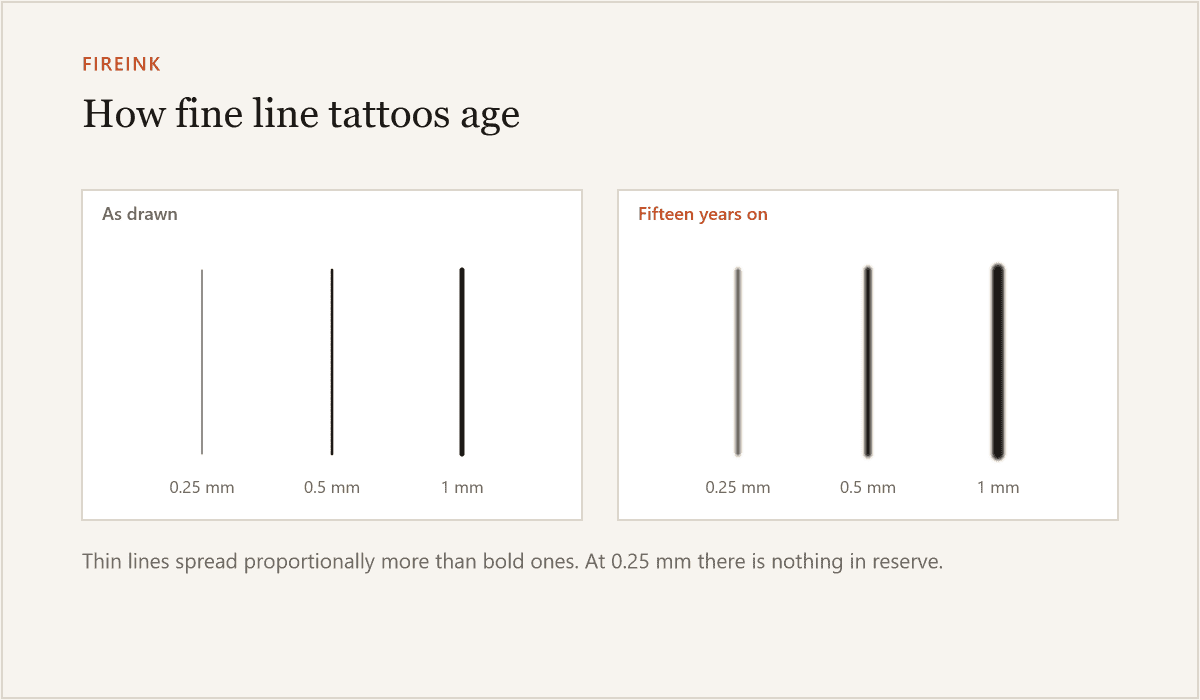
Thin lines spread as they age. This is not a flaw in the artist’s work. It’s biology.
Your immune system treats ink particles as foreign material and slowly breaks them down. Macrophages, the cells that engulf the ink, can drift over time.
The line softens. It gets slightly wider. It loses that razor edge.
Healing softens detail too. During the first month, your body forms new skin over the ink. That new layer acts like frosted glass.
Fine details that looked sharp on day one settle into something gentler. This is why leaving space between elements matters so much.
Two lines placed a millimetre apart will eventually blur toward each other. Give them room.
A well-placed fine line tattoo can still look beautiful after a decade. It won’t look identical to day one. It will look like a softer version of itself.
Some people love that. Others don’t.
Know which one you are before you book.
Choosing an artist for fine line work
Not every tattooer does fine line well. It requires a steady hand, a specific needle configuration, and experience with how thin ink settles over time. Ask to see healed work, not just fresh photos.
Fresh photos show what the tattoo looked like for one day. Healed photos show what it actually became.
Red flag: an artist who only posts fresh work or refuses to show healed examples. Fine line tattoos change more than bold ones. You need to see that change.
Look for consistency. Do the lines in their healed photos still read clearly? Is there visible spread, and is it even? A good fine line artist designs for the future, not for the Instagram post.
Price matters less than you think. The difference between a £150 fine line tattoo and a £400 one is often the artist’s understanding of how ink ages. Pay for that knowledge.
Aftercare that protects thin lines
Fine line tattoos heal faster than bold work because there’s less trauma to the skin. That’s the good news. The bad news is that over-moisturising or picking at scabs damages thin lines more visibly. Sun is the other half of it: UV breaks pigment down, so keeping a healed piece covered or using a high-factor sunscreen, along the lines the NHS sun safety guidance sets out, buys a thin line years.
A small scar on a bold tattoo hides in the shading. On a fine line piece, it’s the whole show.
Keep it simple. Wash gently with unscented soap. Pat dry, don’t rub.
Apply a thin layer of unscented moisturiser twice a day. No soaking, no sun, no scratching.
Sun exposure fades fine lines quickly, so once it’s healed, sunscreen becomes your daily habit.
If a scab forms, leave it alone. Pulling it off early takes ink with it. That leaves a gap in the line. Touch-ups fix this, but prevention is cheaper and less painful.
Fine line vs minimalist
People use these terms interchangeably, but they’re not the same. Fine line refers to the technique: thin needles, light pressure, delicate lines. Minimalist refers to the design: simple shapes, lots of empty space, few elements.
A minimalist tattoo can be done with bold lines. A fine line tattoo can be highly detailed and complex. The two often overlap, which is why the confusion exists. But when you’re researching artists, search for the technique you want, not just the aesthetic.
An artist who specialises in minimalist geometric work might not have the needle control for a detailed fine line botanical piece. Ask about their experience with the specific line weight you want.
Want to see an idea drawn this way before you book? The fine line tattoo generator draws it in 30 to 60 seconds — free, no signup, nothing uploaded. Take the result to an artist as a starting point.
FAQ
Do fine line tattoos hurt more? Generally less. A single needle causes less trauma than a thick grouping. The sensation is more like a sharp scratch than a deep vibration.
How long do fine line tattoos take? Depends on size and detail. A small piece might take 30 minutes. A detailed forearm piece could take three hours. The needle moves slowly because precision matters.
Can fine line tattoos be removed? Yes, and often more easily than bold work. Less ink means fewer laser sessions. But removal is still painful, expensive, and not guaranteed to be complete.
Do fine line tattoos need touch-ups? Many do. A touch-up session a few months after healing can sharpen areas where ink settled unevenly. Budget for it when you plan the tattoo.
What’s the smallest fine line tattoo that still ages well? There’s no universal answer. It depends on placement and skin type. A general rule: if the design requires a magnifying glass to appreciate, it will not age well. Give the lines room to breathe.