AI disclosure: this content, including any imagery, was artificially generated.
Why finger tattoos are the hardest placement
Finger tattoos fade faster than anywhere else on the body. The skin there is thin, the joints move constantly, and your hands get washed more than any other part of you. Ink simply does not stay put the way it does on a forearm or a calf.
That is not a warning to avoid them. It is the reality you need to accept before you book. Go in expecting touch-ups and you will love the result. Go in expecting a crisp, permanent line and you will be disappointed within a year.
Fingers are a high-traffic area. You bend them hundreds of times a day. You wash them after the loo, before food, after touching anything sticky.
Soap, friction and movement all push ink out of the skin. The top of the finger fades differently from the side, and the inner finger is its own challenge entirely.
Some artists refuse to do finger tattoos. That is not a judgement on their skill. It is a judgement on longevity. A good artist knows the work will blur and soften, and some would rather not put their name to something that will look worn within months.
Which designs survive and which blur
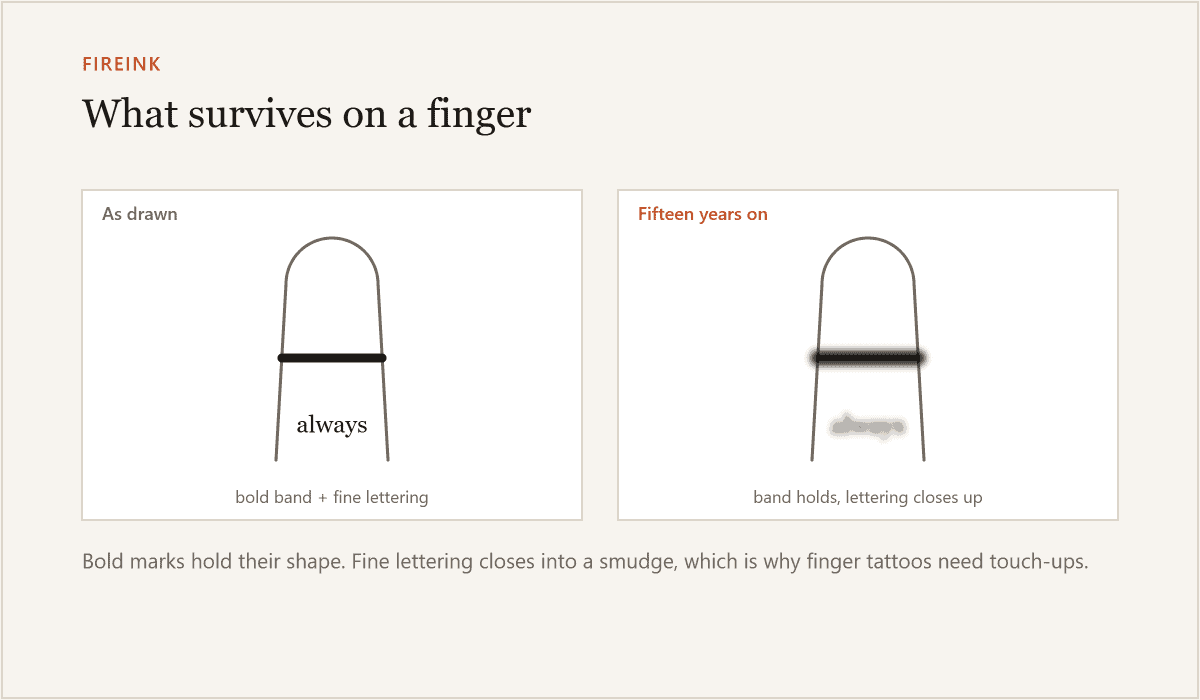
Bold, simple shapes hold up best. A thick line, a solid dot, a small geometric mark: the same stripped-back approach that ages well elsewhere on the body. These read clearly even as the ink spreads slightly under the skin. Fine lettering, tiny stars and delicate fine line work are the first to blur into an unreadable smudge. The tattoo design generator will draw a subject at finger scale, which is the quickest way to see how much detail actually survives at that size.
Black ink outperforms colour. White ink fades fastest of all, often disappearing within weeks. Red and yellow can look lovely for a short while, then turn patchy.
If you want a colour finger tattoo, ask your artist for a healed photo from a previous client. Not a fresh one.
Fresh photos lie.
Size matters more here than anywhere else. A design that is too small for the space will close up as the ink spreads. Give the design room to breathe. A single bold symbol beats five tiny ones every time.
Sides, tops and inner fingers compared
The top of the finger holds ink best. The skin is slightly thicker and sees less friction than the sides. A simple design on the top can last years with only minor softening.
Sides of fingers fade quicker. The skin rubs against neighbouring fingers all day. Ink there often drops out in patches, especially near the knuckle.
Inner fingers are the most difficult. The skin is soft, constantly moist from hand-washing, and rarely sees the light of day.
Ink on the inner finger can disappear almost entirely within months.
That does not mean inner finger tattoos are pointless. It means you need to accept them as temporary. Some people love that. They treat it like a rotating canvas, redoing the design every year or so.
Pain, honestly
Finger tattoos hurt. The skin sits close to bone and there is almost no fat to cushion the needle. The sensation is sharp and immediate, like a hot scratch. Most people rate it higher on the pain scale than a forearm or upper arm tattoo.
The good news is that finger tattoos are small. The pain is intense but brief. A simple design takes ten to twenty minutes.
You can absolutely sit through it. Just do not expect it to feel like a gentle tickle.
Healing is awkward too. You use your hands for everything. Bending a fresh finger tattoo can crack the scab and pull ink out.
Keeping it dry while washing your hands is a genuine challenge. Many artists recommend dry healing for fingers, which means no heavy moisturiser for the first week.
Touch-ups: how often, roughly what cost
Touch-ups are normal here. They are not a sign that your artist failed or that your skin rejected the ink. Fingers simply shed ink faster than other placements.
Most people need a touch-up within six to twelve months. Some need one sooner.
A touch-up session is usually quick. The artist reworks the faded areas, often for a reduced fee. Some artists include one free touch-up within a set period, usually three to six months.
Others charge a small fee, typically £30 to £60 depending on the studio. Ask about this before you book.
It is a fair question and a good artist will answer it directly.
After the first touch-up, the design often settles better. The skin has healed once already and the artist can see exactly where the ink dropped out. The second pass usually lasts longer than the first.
Finding an artist who will do finger tattoos
Not every tattooist offers finger work. Some decline outright. Others will do it but only if you understand the fading risk. Whoever you settle on should be registered with its local council, which is a legal requirement for tattooing in England and Wales.
That conversation is a good sign. An artist who warns you about longevity is being honest, not difficult.
Look for an artist who posts healed finger tattoos on their Instagram. Fresh photos are easy to find. Healed photos, taken months later, are rare and far more useful. If an artist has no healed finger work to show, that tells you something.
A reference design is a starting point to take to an artist. It is never “your tattoo” and never a claim about what will end up on skin. Your artist will adapt it to fit your finger, your skin type and their experience.
Trust that adaptation. A design that works on paper does not always work on a curved, moving finger.
Want to see how much detail survives at finger size? Choose finger and tiny in the tattoo design generator and it draws a version simple enough for the placement in 30 to 60 seconds — free, no signup, nothing uploaded. Take the result to an artist as a starting point.
FAQ
Do finger tattoos always fade? Yes, to some degree. The amount varies by placement, design and skin type, but some fading is guaranteed. Expect it.
How long do they last before needing a touch-up? Most people need a touch-up within a year. Tops of fingers can go longer. Inner fingers often need work within months.
Can I get a white ink finger tattoo? You can, but it will fade fast. White ink on fingers often vanishes within weeks. Most artists advise against it.
Will it hurt more than other tattoos? Yes. The skin is thin and close to bone. The pain is sharp but short-lived because the design is small.
Why did an artist refuse my finger tattoo? Likely because they know it will fade and they do not want to be responsible for a result that disappoints you. It is about longevity, not skill.
Finger tattoos are cool. They are also the highest-maintenance placement there is. If you want one, get one. Just walk in with your eyes open and a plan for the touch-up that will almost certainly follow.